The Contradictions Between Jesus’s Teachings and Pauline Theology
Introduction
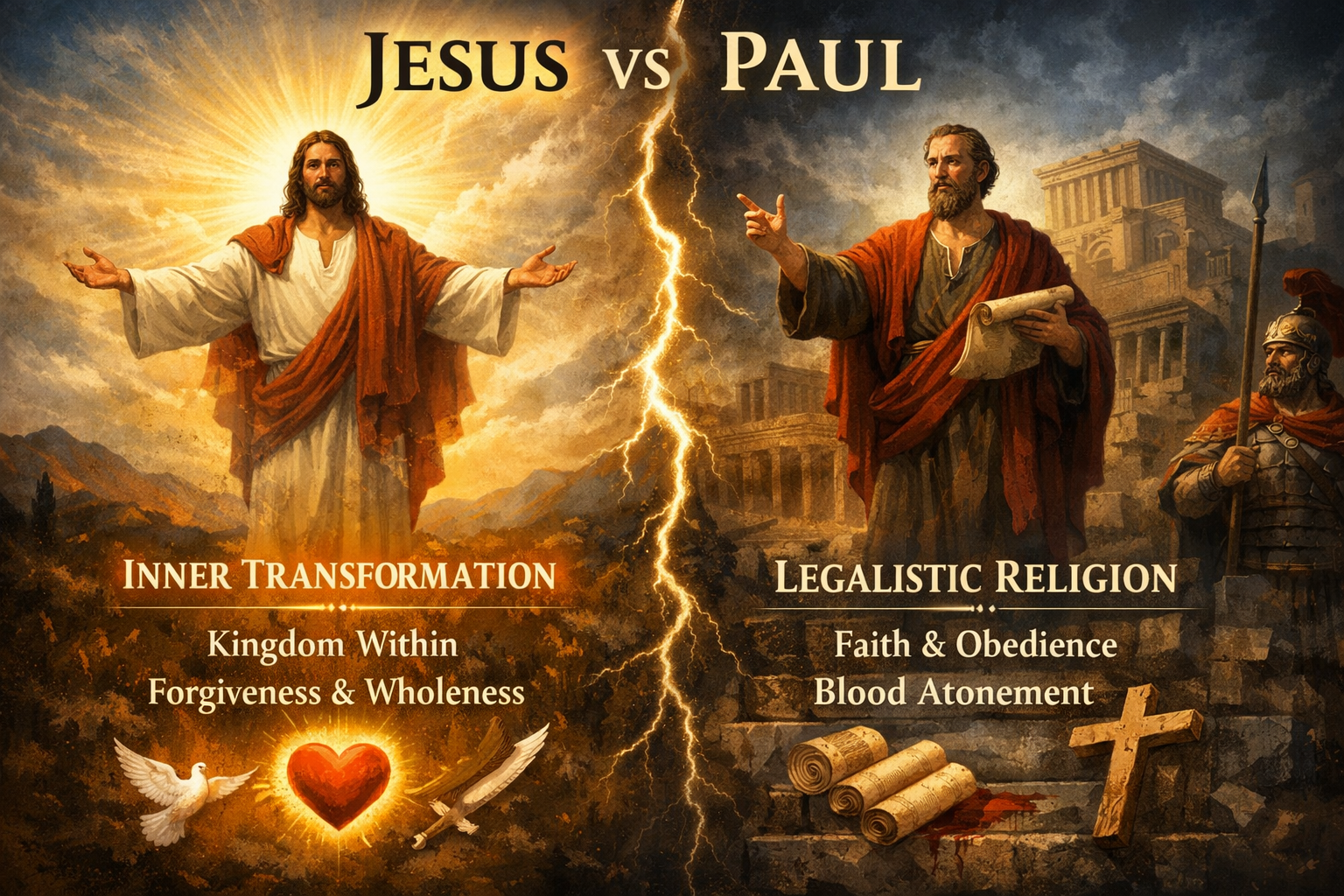
Within the New Testament, two distinct theological frameworks emerge that shape how salvation, law, human nature, and the relationship with God are understood. When examined side by side, the teachings attributed to Jesus and the writings attributed to Paul reveal deep and persistent tensions. These differences are not merely stylistic or interpretive but reflect fundamentally opposing spiritual models—one centered on inner transformation and lived awareness, the other on legal status, mediation, and contractual belief.
This article explores those contrasts across key theological themes, highlighting how the message of Jesus and the theology developed by Paul diverge in purpose, method, and outcome.
Salvation: Inner Transformation vs. Legal Standing
Jesus consistently frames salvation as an internal, lived reality. The kingdom of God is described as present within the individual, and healing or forgiveness is tied to awareness, repentance, and personal transformation. Statements such as “your faith has made you whole” point to restoration as a change in consciousness and alignment, not a legal declaration.
In contrast, Paul presents salvation as a juridical event. Salvation is described as something conferred through belief, confession, and faith in a specific redemptive mechanism. Justification becomes a change in legal standing before God rather than an inner transformation. Where Jesus emphasizes becoming whole, Paul emphasizes being declared righteous.
Similarly, Jesus addresses sin as something that can be overcome through awareness and change—“go and sin no more”—while Paul universalizes sin as an inherited condition requiring a legal remedy applied externally to the individual.
Redemption: Mutual Forgiveness vs. Blood Transaction
Forgiveness in Jesus’s teaching is reciprocal and relational. Forgiving others is directly linked to being forgiven, and no sacrificial mechanism is required to activate grace. Mercy, reconciliation, and restored relationship are central.
Pauline theology reframes redemption as a transaction accomplished through blood. Forgiveness becomes dependent on a sacrificial payment, transforming reconciliation into a legal settlement. This shift reintroduces a sacrificial framework that Jesus explicitly challenged when prioritizing mercy over sacrifice.
Jesus’s death is portrayed as a conscious offering—an act freely given—whereas Paul interprets it as a substitutionary payment made on behalf of others to satisfy a judicial requirement.
The Goal of Spiritual Life: Wholeness vs. Endless Striving
Jesus presents spiritual maturity as attainable. The call to be “perfect” reflects wholeness, integration, and alignment with divine life. The implication is that transformation is possible here and now.
Paul, however, depicts spiritual life as ongoing struggle. He describes himself as not having attained the goal and as perpetually pressing forward, burdened by internal conflict and inadequacy. This framework normalizes spiritual incompleteness and reinforces dependence on external justification rather than inner realization.
Law and Ethics: Heart Alignment vs. Faith Contract
Jesus reframes the law as an internal reality—rooted in intention, compassion, and lived action. Ethical behavior flows from the heart, and responsibility is personal and relational.
Paul replaces this internal ethic with what can be described as a faith-based contract. Righteousness is no longer measured by transformed behavior or inner alignment but by adherence to belief. This shift creates moral ambiguity, where actions may be considered permissible based on belief status rather than intrinsic alignment with love or justice.
God and Humanity: Unity vs. Mediation
Jesus portrays God as Spirit and emphasizes direct relationship and unity. Humanity is described as carrying divine light, with no inherent distance between the individual and God. Union, not separation, is the goal.
Paul presents a markedly different anthropology. God becomes primarily a judge, humanity is inherently flawed, and access to God is mediated through an intermediary structure. Rather than dissolving distance, this model formalizes and preserves it.
Social Order and Power: Deconstruction vs. Accommodation
Jesus consistently subverts hierarchy. Authority is inverted, greatness is defined by service, and violence is rejected. His teaching undermines domination and challenges systems of power.
Paul’s writings, however, accommodate existing social structures. Submission to governing authorities, acceptance of hierarchy, and endorsement of coercive power are presented as divinely sanctioned. This shift reconciles spiritual life with empire rather than challenging it.
Conclusion: Two Opposing Spiritual Frameworks
When examined closely, the teachings of Jesus and the theology developed by Paul represent two incompatible spiritual visions. One emphasizes inner awakening, direct relationship with God, and liberation from religious control. The other constructs a system of belief, mediation, legal justification, and hierarchical authority.
In essence, Jesus teaches a path that dissolves separation through awareness and transformation, while Pauline theology institutionalizes separation through doctrine and contract. Understanding this distinction is critical for anyone seeking to discern the foundations of Christian theology and the implications of how salvation, authority, and spiritual life are understood.