Reinterpreting Eden: Consciousness, Control, and the Origins of a Sacred Story
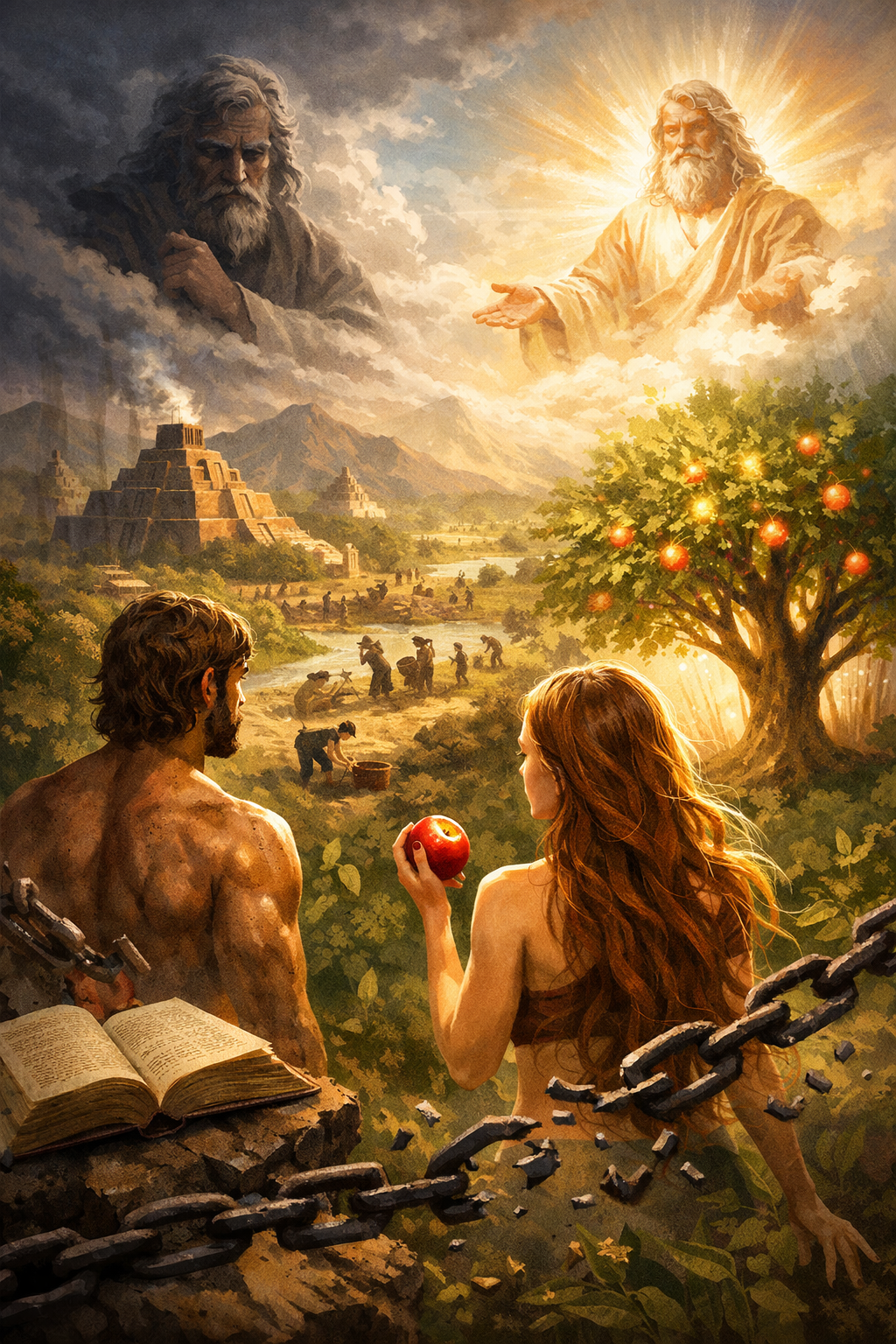
Ancient religious texts are often approached as timeless, divinely dictated truths. Yet another way to engage them is to read them as historical artifacts—stories shaped by culture, power structures, and human experience. When viewed through this lens, familiar narratives can take on radically different meanings. One such narrative is the story of the Garden of Eden.
Rather than a tale about moral failure and divine punishment, Eden can be reimagined as a story about control, labor, and the awakening of human consciousness. This reinterpretation challenges long-held assumptions about the purpose of humanity, the nature of the divine, and the role of awareness itself.
Sacred Texts as Human Compositions
When ancient scriptures are treated as historically situated writings rather than literal transcripts from heaven, their symbolic and political dimensions come into sharper focus. These texts emerge from specific moments in history, shaped by the knowledge, myths, and power dynamics of their time. Reading them this way does not diminish their value; instead, it opens space for deeper meaning and personal liberation.
In this framing, religious stories are not mechanisms of fear or obedience but coded narratives that can be decoded and re-understood. The goal shifts from defending rigid doctrines to uncovering insight, wisdom, and inner truth.
Eden as a Labor Narrative
In this reinterpretation, the Garden of Eden is not primarily a paradise of leisure and intimacy, but a place of assigned function. Humanity is placed in the garden “to work and keep it,” language that reads less like companionship and more like a job description. The repeated emphasis on cultivation, maintenance, and productivity suggests a system designed around labor.
Even seemingly incidental details—such as references to valuable resources—take on new meaning in this context. What appears out of place in a purely spiritual paradise becomes logical in a setting centered on production and extraction. Eden, in this light, resembles a managed environment rather than a sanctuary of freedom.
The Awakening of Consciousness
The pivotal moment in the Eden story is not disobedience, but awareness. The so-called “forbidden knowledge” leads to opened eyes, self-recognition, and moral discernment. This awakening is portrayed as dangerous—not because it corrupts humanity, but because it disrupts the existing order.
Once conscious, humans are no longer passive participants in a system they do not understand. Awareness threatens control. From this perspective, the expulsion from the garden is not an act of wrath, but a calculated response to newly awakened beings who can no longer be easily managed.
Here, consciousness itself becomes the true spiritual act. Knowledge is not sin; it is liberation.
Rethinking the Divine Image
This reinterpretation also transforms the image of the divine. Rather than a surveilling authority who punishes curiosity, the divine source can be understood as fundamentally loving and present. The harsh, managerial figure often associated with early narratives dissolves when those stories are seen as symbolic or political rather than literal.
This shift resolves a deep moral tension found in traditional readings: the idea that humanity is punished simply for wanting to know, to grow, or to become aware. By separating the loving source of creation from controlling systems embedded in ancient narratives, the divine is reclaimed as unconditional rather than punitive.
Freedom Beyond Fear
Seen this way, the Eden story is not about humanity’s fall, but humanity’s first awakening. It is the moment when awareness enters the human experience—and when systems of control respond with exclusion rather than embrace.
This perspective invites a profound reevaluation of faith itself. Spiritual life becomes less about submission to external authority and more about trust, inner knowing, and freedom. Liberation replaces fear. Awareness replaces shame. Connection replaces control.
When sacred stories are re-read through the lens of consciousness and historical context, they cease to bind and begin to free. The garden is no longer lost; it is outgrown.