When Faith Becomes a System: Rethinking Institutional Christianity
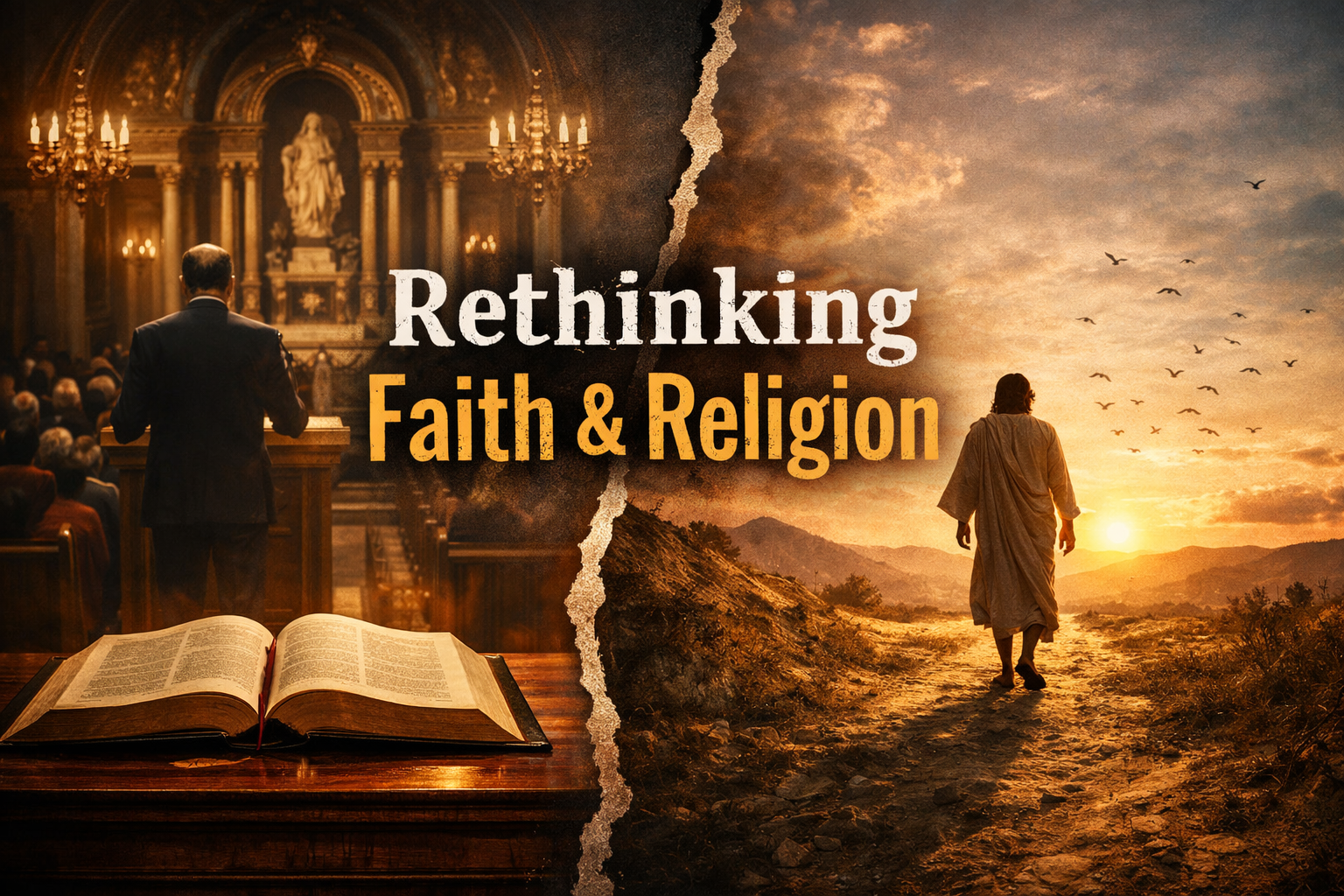
At its heart, faith was never meant to be complicated. It was never meant to be managed, gated, or mediated through layers of authority. And yet, much of what passes for modern Christianity today bears little resemblance to a message of freedom. Instead, it often looks like a tightly controlled system—one built on rules, reputations, hierarchies, and enforced conformity rather than transformation.
This raises a difficult but necessary question: When does religion stop pointing toward God and start replacing Him?
The Subtle Shift from Faith to Idolatry
Idolatry is often imagined as something ancient—golden statues or pagan rituals. But idolatry can be far more subtle. It occurs anytime something is placed between a person and God.
Over time, institutions can quietly take that place. Systems form. Doctrines harden. Leaders become unquestionable. Buildings are treated as sacred in themselves. Even holy texts—meant to guide—can be elevated beyond their purpose and treated as the object of devotion rather than a witness pointing beyond itself.
None of these things are inherently wrong. The danger arises when they become substitutes for direct relationship. When faith becomes about compliance rather than connection, devotion rather than love, identity rather than transformation, something essential has been lost .
Freedom Was the Original Message
The original message of the gospel was not institutional loyalty—it was liberation. It challenged religious control, not reinforced it. It dismantled spiritual gatekeeping and replaced it with direct access to God.
Faith was never meant to be outsourced. No intermediary was required. No spiritual middle management stood between the individual and the divine. The invitation was deeply personal: seek, ask, knock. Work out faith not through ritual performance but through lived love, humility, and mercy.
When religion reintroduces barriers that faith once removed, it betrays its own foundation .
A Familiar Historical Pattern
History offers a sobering warning. Those most confident in their religious authority have often been the quickest to judge, exclude, and condemn. The most dangerous form of faith is not irreverence, but certainty—especially when certainty is wielded as a weapon.
The irony is painful: the people most convinced they were defending God once opposed Him entirely. Their devotion to structure, status, and moral superiority blinded them to truth standing directly in front of them.
That same pattern repeats whenever faith becomes about protecting systems rather than people, rules rather than compassion, power rather than service .
How Easily Truth Is Manipulated
There is a haunting lesson in how quickly devotion can be redirected. Crowds that celebrate truth one day can be persuaded to reject it the next. When belief is shaped by authority rather than conviction, it becomes dangerously fragile.
Institutional power has the ability to redefine faith on demand—to label truth as heresy and love as rebellion. In doing so, it trains followers not to discern truth, but to obey consensus. This is how systems preserve themselves, even at the cost of their original purpose .
Returning to Authentic Discipleship
This critique is not a rejection of faith, nor a condemnation of religious people. Many sincere, compassionate, deeply loving individuals exist within religious systems. The issue is not belief—it is misplaced worship.
Authentic discipleship begins when allegiance shifts away from institutions and back toward lived truth. It looks like humility instead of certainty, love instead of judgment, and courage instead of conformity.
It means refusing to let any system define who God is for us. It means measuring faith not by doctrinal alignment but by how we treat our neighbor. And it means asking a difficult final question:
If truth appeared today in an unexpected form—unpolished, unfamiliar, and disruptive—would we recognize it? Or would we defend the system that taught us not to?