The Bible, Jesus, and the Human Making of Scripture
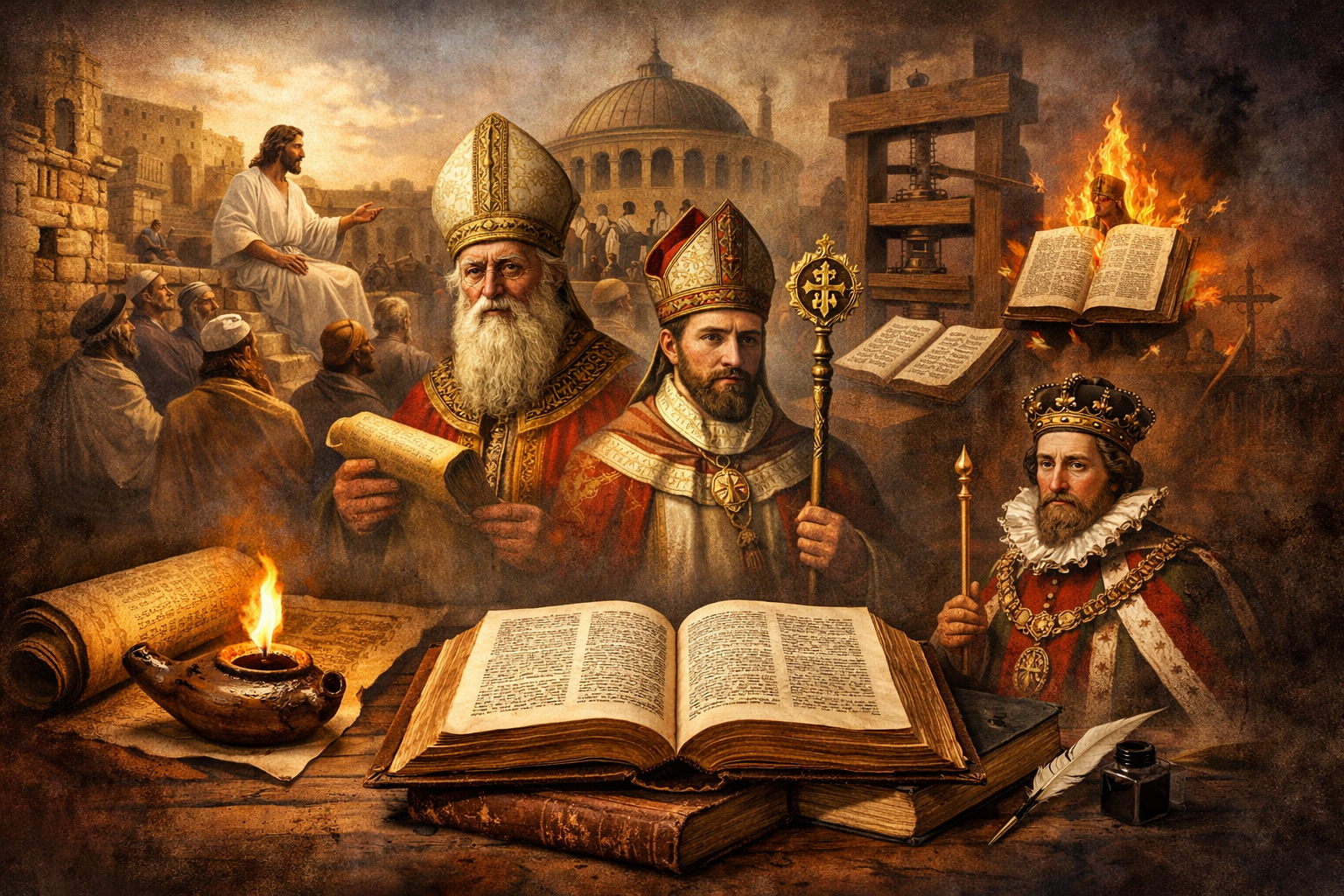
Introduction: A Book That Did Not Yet Exist
Many people today assume that the Bible existed during the lifetime of Jesus and that it represents the direct, unaltered words of God. Historically, this is not the case. The Bible as we know it did not exist in the first century. Jesus never read from it, never wrote a book, and never instructed his followers to compile one. Instead, his teachings emerged within an oral culture where wisdom was spoken, memorized, and lived rather than written and standardized.
Understanding how the Bible came to be—when it was written, who decided its contents, and how it was later translated and edited—reveals that it is a collection of texts shaped by human hands, theological debates, and political power, rather than a single divine manuscript delivered intact from heaven.
1. Jesus and the Oral Tradition of His Time
Jesus lived in a predominantly oral society. Literacy rates in first-century Judea were low, and religious instruction was passed on through storytelling, repetition, and communal memory. Teachers spoke in parables and short sayings that could be easily remembered and shared.
The Gospels themselves preserve this oral character:
“He who has ears to hear, let him hear.” (Mark 4:9)
“The kingdom of God is within you.” (Luke 17:21)
These statements emphasize listening, perception, and inner awareness, not textual authority. Jesus did not point people to a book but to transformation, compassion, and discernment. He wrote nothing, and no written account of his teachings exists from his lifetime. At the time of his death (around 30–33 CE), there was no New Testament and no defined Christian scripture.
2. From Spoken Word to Written Text
The earliest Christian writings appeared decades after Jesus’ death. The letters attributed to Paul are generally dated to 50–60 CE, written to specific communities to address disputes, behavior, and belief. These letters were not biographies of Jesus, nor did they record his sayings in narrative form.
The Gospels were written later:
Mark: approximately 70 CE
Matthew and Luke: approximately 80–90 CE
John: approximately 90–100 CE
These writings were composed from oral traditions, memory, and theological interpretation. They were not eyewitness transcripts. Different communities preserved different collections of teachings, stories, and sayings. Many writings circulated in the early centuries, including texts attributed to Thomas, Mary, and Philip, alongside numerous other gospels, letters, and apocalypses.
There was no universal agreement on which texts were authoritative.
3. Canon Formation and the Power to Decide
The idea of a fixed biblical canon emerged much later, primarily in the fourth century CE, after Christianity became aligned with imperial authority.
Key developments include:
313 CE – Christianity legalized within the Roman Empire
325 CE – Council of Nicaea, which helped establish centralized doctrinal authority
367 CE – The first surviving list of the 27 New Testament books that later became standard
Church leaders debated which writings were acceptable and which were to be excluded. Texts that aligned with emerging institutional structures were preserved, while others were rejected, suppressed, or destroyed. These decisions were made by councils of men operating within political, cultural, and theological constraints.
This process of selection was not presented as ongoing revelation but as final authority—despite the fact that alternative writings and traditions had existed for generations.
4. The Latin Bible and a Millennium of Mediation
In the late fourth century, the scriptures were translated into Latin, forming what became known as the Latin Vulgate. For approximately 1,000 years, this version dominated Christian life in Western Europe.
During this period:
Scripture was inaccessible to most people
Interpretation belonged almost exclusively to clergy
Ordinary believers could not read the Bible for themselves
Meaning was mediated through institutional authority rather than personal engagement. This separation between people and text allowed doctrine to be enforced without challenge and interpretation to remain centralized.
5. Translation as a Threat
When individuals attempted to translate scripture into common languages, they were often accused of heresy. Making the Bible readable to ordinary people was treated as dangerous because it shifted interpretive power away from institutions.
Those who translated or distributed vernacular scriptures faced persecution and death. The history of translation demonstrates that access to the text was not always encouraged; it was often feared.
6. The King James Bible and Political Authority
In 1611, King James I of England authorized a new English translation of the Bible. This translation was intended to unify religious practice under royal authority and to replace earlier English versions that were viewed as politically and theologically threatening.
The King James Bible was carefully worded and stylistically elevated, but it was also shaped by the priorities of church and crown. Language choices reinforced hierarchy, obedience, and centralized power. While revered by many today, this translation reflects the political and theological concerns of its time rather than an untouched divine voice.
7. Are the Words of the Bible the Words of God?
Even within scripture, a distinction is made between written words and living truth:
“The letter kills, but the Spirit gives life.” (2 Corinthians 3:6)
“Why do you call me ‘Lord, Lord,’ and do not do what I say?” (Luke 6:46)
Jesus consistently emphasized inner transformation, compassion, and lived practice over legalism or textual authority. The belief that the Bible is the literal, inerrant word of God emerged long after Jesus’ lifetime, following centuries of selection, translation, and institutional control.
Conclusion: Reading the Bible with Historical Honesty
The Bible did not exist during the life of Jesus. It was written later, assembled gradually, filtered through councils, locked in elite languages, and shaped by political power—including royal authority. Acknowledging this history does not require rejecting scripture, but it does require rejecting the idea that the Bible is a flawless transcript of divine speech.
Reading the Bible honestly allows its writings to be engaged as spiritual literature shaped by human context. It also returns responsibility to the reader—to discern meaning, test teachings by their fruits (Matthew 7:16), and recognize that truth cannot be confined to a book.
What Jesus pointed toward was not a future canon, but a present reality—one that he described simply and repeatedly: the kingdom of God is within you.