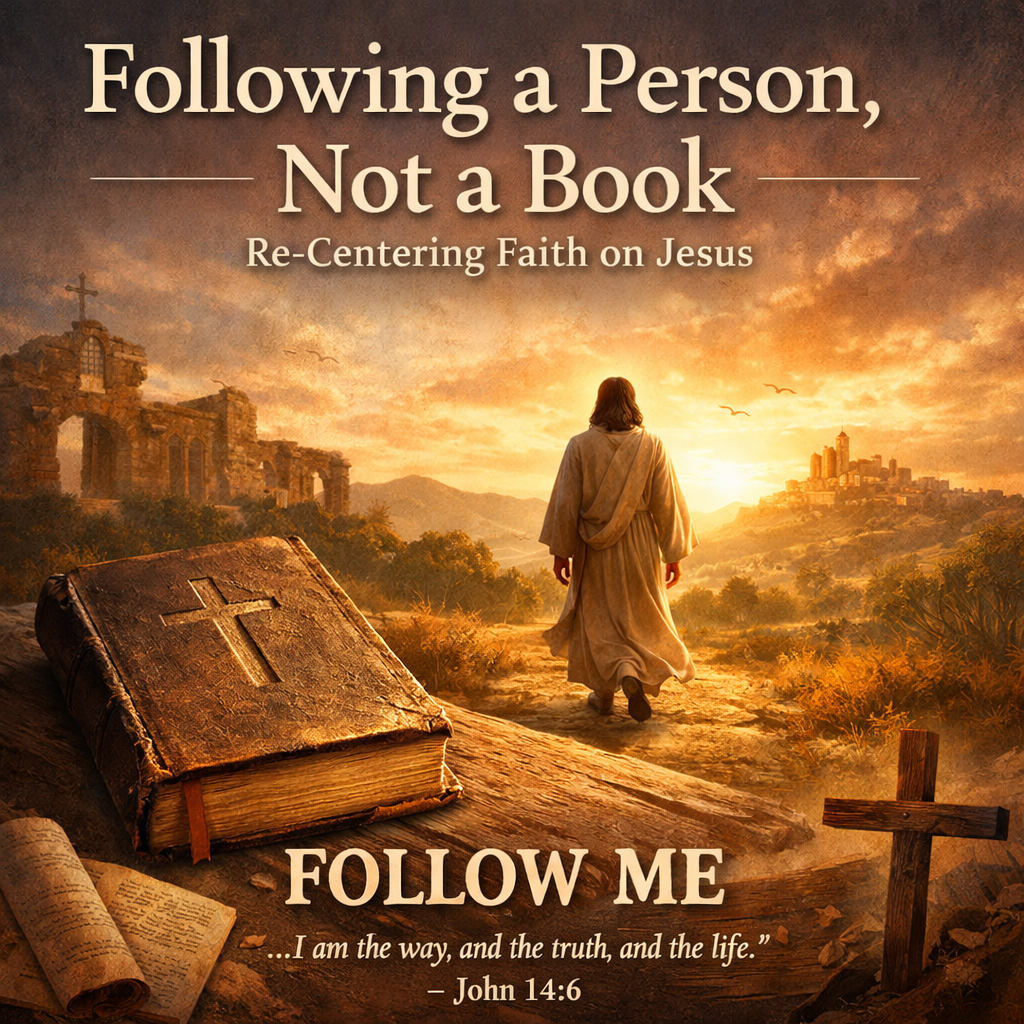
Following a Person, Not a Book
Canon Formation, Jesus-Centered Faith, and the Humanity of Scripture
For many believers, faith has long been centered on a book assumed to be flawless, final, and divinely authored in every detail. Yet a closer look at history, scripture, and the message of Jesus himself invites a more honest and liberating reflection. When examined carefully, the formation of the biblical canon, the life and teachings of Jesus, and the lived reality of Christianity all point toward a faith grounded not in textual perfection, but in a person.
The Bible and Its Formation
A compiled Christian Bible did not exist during the lifetimes of Jesus, his earliest followers, or even the writers of the Gospels. The texts that later became “Scripture” circulated independently for generations before being gathered, evaluated, debated, and formally selected centuries after the events they describe. This process involved extensive human decision-making: writing and rewriting, translation and retranslation, and filtering through political, cultural, and theological priorities.
Canon formation was not a single divine act, but a historical process shaped by councils, votes, and authority structures. Recognizing this does not diminish the value of scripture; rather, it situates it honestly as a human witness to divine encounters. The Bible did not descend whole from heaven, nor was it authored directly by God’s hand. It emerged through people—faithful, flawed, sincere, and limited.
Acknowledging this humanity does not weaken faith. It clarifies it.
Scripture as Human Witness, Not an Idol
Treating the Bible as if it were God himself risks turning scripture into an object of worship rather than a guide toward truth. Scripture points beyond itself. It bears witness. It invites reflection, discernment, and transformation. But it was never meant to replace the living call at the center of the gospel.
Jesus never instructed anyone to “read my book.” No such book existed. Instead, his invitation was relational and immediate:
“Follow me.” (Matthew 4:19)
This distinction matters. Faith rooted in rigid textual inerrancy often collapses into defensiveness, division, and control. Faith rooted in following Jesus leads toward humility, freedom, and transformation.
Jesus and the Heart of the Gospel
Jesus was Jewish and did not set out to establish a new religion. His message was not about constructing institutions, denominations, or doctrinal systems, but about awakening hearts to truth. He spoke of inner transformation, calling people toward love of God and neighbor, forgiveness, and freedom.
When asked about greatness in the kingdom, Jesus pointed not to scholars or authorities, but to children:
“Unless you change and become like little children, you will never enter the kingdom of heaven.” (Matthew 18:3)
This simplicity stands in contrast to centuries of increasingly complex theological disputes. Over time, disagreements about interpretation hardened into divisions, producing tens of thousands of denominations, each claiming certainty. The result has often been confusion rather than clarity.
Tensions Within the Text
Readers of the Bible encounter striking contrasts within its pages. Some passages portray a punitive and violent depiction of God, while others—especially in the teachings of Jesus—emphasize mercy, forgiveness, and love of enemies:
“Love your enemies and pray for those who persecute you.” (Matthew 5:44)
These tensions have long challenged believers. Rather than forcing all portrayals into a single flattened image, a Jesus-centered reading asks a different question: What does Jesus reveal about God? The Gospels present Jesus as the clearest lens through which to understand divine character—a lens marked by compassion, self-giving love, and grace.
Freedom, Not Control
At its core, the gospel is about freedom. Where faith becomes a tool for control, exclusion, or fear, it drifts from its source. Jesus consistently resisted religious systems that burdened people with rules while neglecting mercy:
“The Sabbath was made for man, not man for the Sabbath.” (Mark 2:27)
Faith was meant to bring life, not anxiety; wholeness, not fragmentation. Returning to a Jesus-centered faith invites believers to hold scripture deeply and reverently, without confusing it for God himself.
Re-Centering Faith
The Bible remains invaluable—worthy of study, reflection, and daily engagement. But it is a means, not the end. The invitation of the gospel has always been personal and relational:
“I am the way, and the truth, and the life.” (John 14:6)
To follow Jesus is to embrace humility, to seek truth beyond rigid dogma, and to live out love in tangible ways. Recognizing the Bible’s human formation does not undermine faith—it frees it, redirecting attention from defending a text to embodying a way of life.
In the end, faith was never meant to be built on the minutes of ancient meetings or the perfection of pages, but on the living call that still echoes today: follow me.