When Was Hell Created?
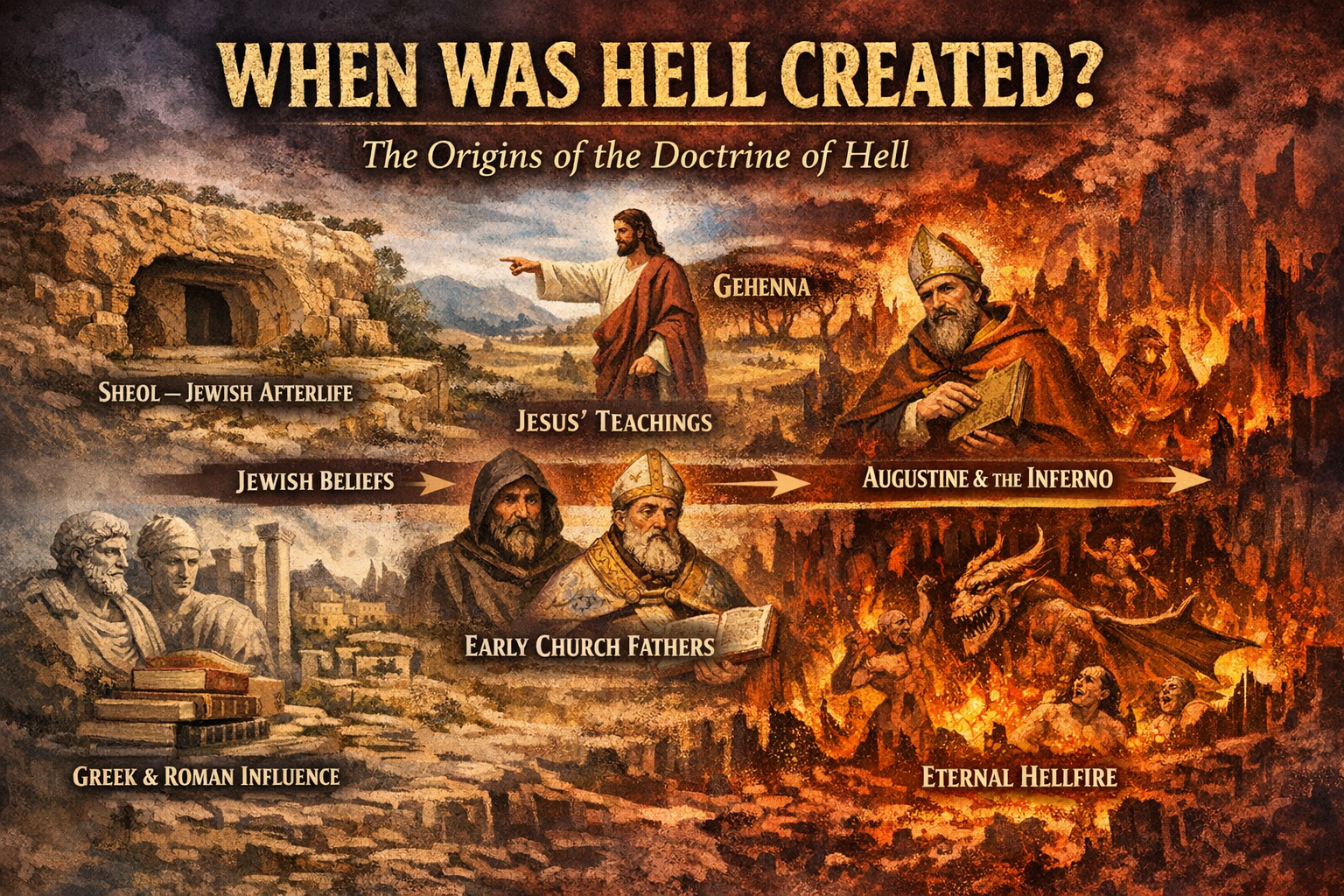
A Historical Look at How the Doctrine of Hell Developed
The modern concept of hell as a place of eternal conscious torment is so deeply embedded in contemporary Christian thinking that many assume it was a central part of Jesus’ message. However, when examined historically and scripturally, this assumption does not hold. The idea of hell as it is commonly understood today did not exist during Jesus’ lifetime and was developed gradually over centuries through theological interpretation, cultural influence, and institutional authority.
Understanding how this doctrine formed requires distinguishing between what Jesus taught, what earlier Jewish traditions believed, and what later church leaders formalized.
Jewish Beliefs Before and During Jesus’ Time
In the first century, Jewish theology did not include a doctrine of hell as a place of eternal punishment.
Sheol: The Hebrew Afterlife Concept
The Hebrew Scriptures refer to Sheol, a shadowy realm of the dead where all people—righteous and unrighteous—went after death.
“For in death there is no remembrance of you; in Sheol who will give you praise?”
— Psalm 6:5
Sheol was not a place of reward or punishment. It was simply the grave or the state of death.
No Eternal Torment in Early Judaism
There was no belief in:
Eternal conscious punishment
A fiery underworld ruled by demons
Souls suffering endlessly after death
Judgment, when discussed, was typically corporate, earthly, and restorative, not individual and eternal.
What Jesus Actually Taught
Jesus never taught the doctrine of hell as later Christianity would define it.
Gehenna: A Misunderstood Term
Jesus occasionally used the word Gehenna, which is often translated as “hell” in English Bibles. However, Gehenna was:
A physical location outside Jerusalem
Associated with national judgment and destruction, not the afterlife
Symbolic language drawn from Israel’s prophetic tradition
“It is better for you to enter life with one eye than with two eyes to be thrown into Gehenna.”
— Matthew 18:9
Jesus’ audience understood this as a warning about consequences, not a description of eternal torture after death.
Jesus’ Central Message
Jesus consistently taught:
The Kingdom of God
Repentance and transformation
Restoration, mercy, and forgiveness
“I desire mercy, not sacrifice.”
— Matthew 9:13
Notably absent from his teachings:
A detailed doctrine of the afterlife
Eternal punishment of souls
Fear-based salvation messaging
The Shift After Jesus’ Death
The doctrine of hell emerged after Jesus, shaped by new cultural and philosophical influences.
Greek Philosophy Enters Christian Thought
As Christianity spread into the Greco-Roman world, it absorbed ideas from:
Plato, who taught the immortality of the soul
Hellenistic dualism, separating body and soul
These ideas were foreign to Jewish theology but became foundational in later Christian doctrine.
The Early Church Fathers and the Birth of Hell
Between the 2nd and 5th centuries, church leaders began defining doctrines more rigidly.
Key Developments
Eternal punishment became linked to moral control
Immortal souls required eternal destinations
Fear became a tool for reinforcing orthodoxy
By the time Christianity became aligned with imperial power, theological ambiguity was replaced with dogma.
Augustine and Eternal Torment
By the late 4th and early 5th centuries, the idea of eternal conscious torment was firmly established. It became the dominant view within Western Christianity and was later enforced as orthodoxy.
At this point, hell had become:
A permanent afterlife destination
A tool of theological authority
A means of social and moral regulation
Church Councils and Doctrinal Enforcement
As church councils formed and creeds were established, alternative views—such as annihilation or universal reconciliation—were increasingly rejected.
The doctrine of hell was:
Standardized
Institutionalized
Disconnected from its Jewish roots
By the Middle Ages, hell had evolved into the vivid, fear-driven imagery still familiar today.
A Doctrine Shaped by History, Not Jesus
The historical record shows that:
Jesus did not teach hell as eternal torment
Early Judaism did not hold such a belief
The doctrine developed centuries later
Cultural, philosophical, and political forces played a major role
The concept of hell was not revealed—it was constructed.
Why This Matters
Understanding the origins of hell invites deeper reflection on:
The difference between Jesus’ teachings and later theology
How doctrines evolve over time
Whether fear-based belief aligns with a message centered on love, restoration, and grace
Reexamining these ideas does not diminish faith—it grounds it in history and honesty.