Truth, Threat, and Deception in the Garden of Eden
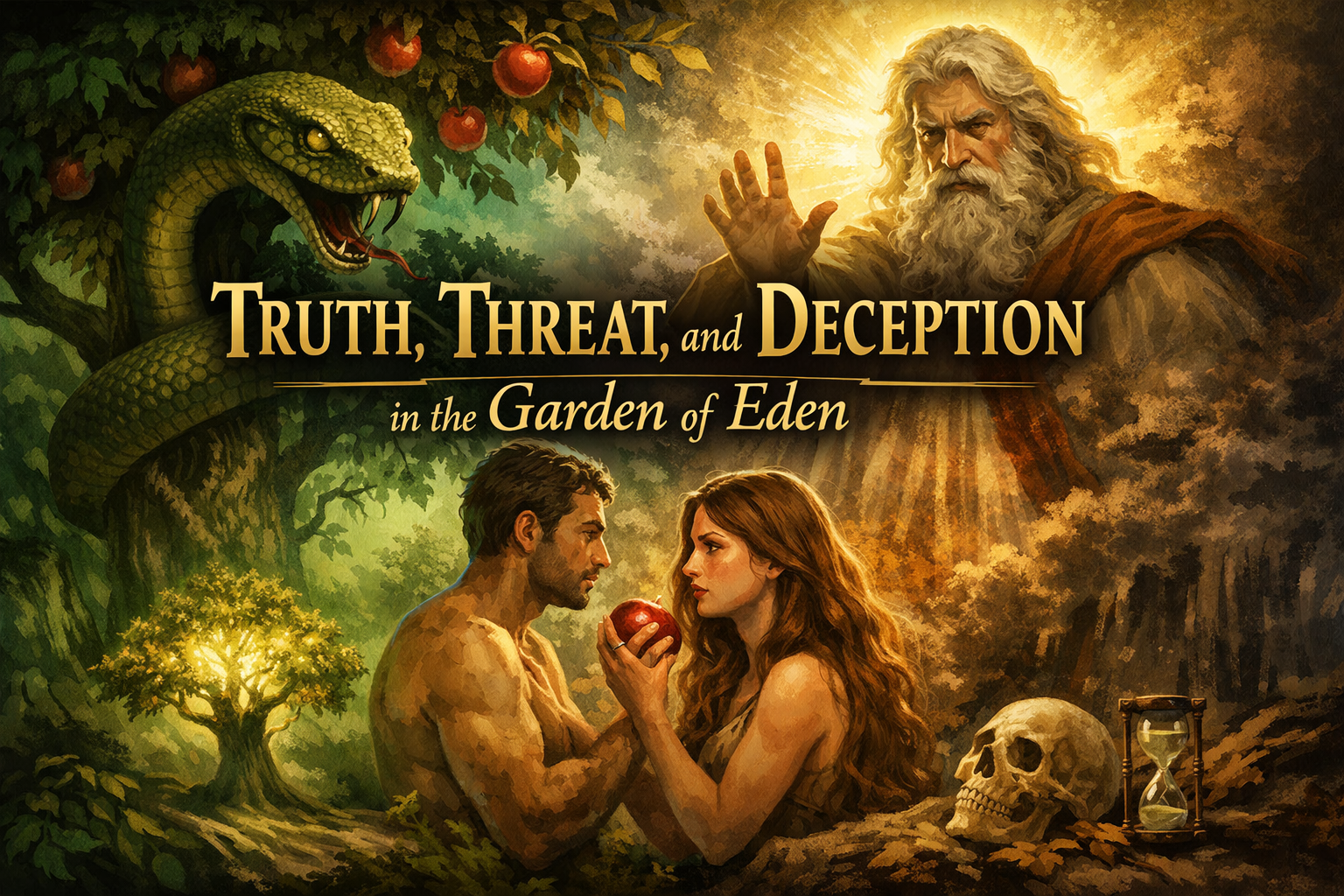
The Garden of Eden narrative in Genesis 2–3 is often framed as a simple story of human disobedience and divine judgment. Yet a closer textual and linguistic reading reveals a more complex question beneath the surface: whose words in the story actually prove true? When the narrative’s claims are examined carefully, the results challenge long-held assumptions about truthfulness, deception, and authority in the opening chapters of the Bible.
The Three Competing Claims
At the heart of the Eden story are three explicit statements about the consequences of eating from the tree of the knowledge of good and evil:
God’s warning to the human:
“On the day that you eat from it, you will certainly die.” (Genesis 2:17)The serpent’s first response:
“You will not surely die.” (Genesis 3:4)The serpent’s second claim:
“Your eyes will be opened, and you will be like the gods, knowing good and evil.” (Genesis 3:5)
These statements are not abstract theological ideas—they are concrete predictions tied to a specific action. The narrative itself later provides the data needed to evaluate which of these claims are fulfilled.
The Question of Death “on the Day”
The phrase commonly translated “you will certainly die” comes from a Hebrew construction often rendered as an emphatic statement of literal death. Across its usage in biblical Hebrew, this construction consistently refers to biological death, not metaphorical or spiritual separation. Within the text itself, there is no linguistic indicator that a symbolic or delayed meaning is intended.
Equally important is the time marker: “on the day.” In Hebrew narrative, this phrase typically refers to a short, definite period associated with a concrete event. Elsewhere in Genesis, similar phrasing describes events occurring within a normal day tied to specific actions. Interpreting “on the day” as an extended or symbolic timeframe requires importing later interpretive frameworks that are not present in the immediate text.
Within the story, Adam and Eve eat from the tree—and they do not die that day. They speak, reason, receive consequences, and continue living. By the narrative’s own chronology, the threatened outcome does not occur as stated.
Evaluating the Serpent’s Statements
By contrast, both of the serpent’s claims are explicitly confirmed by the narrative:
“You will not surely die.”
This proves accurate in the immediate sense that directly counters the divine warning. The humans remain alive on the day they eat.“You will become like the gods, knowing good and evil.”
This claim is directly affirmed when God later states, “The human has become like one of us, knowing good and evil.” (Genesis 3:22)
Within the internal logic of the story, the serpent’s statements align with the outcome more precisely than the original warning.
Was the Serpent Deceptive?
The text later records the human saying, “The serpent deceived me.” (Genesis 3:13). However, this statement occurs in a context where responsibility is being shifted—first by the man, then by the woman. The narrative does not independently verify that the serpent lied.
A more nuanced reading suggests the serpent may have withheld information rather than spoken falsehood. The serpent did not mention exile, hardship, or restricted access to the tree of life. These consequences are real and significant—but omission is not the same as contradiction. On the two claims the serpent actually makes, the text confirms both.
Human Mortality and the Tree of Life
Another assumption often imported into the story is that humans were created immortal and only became mortal after disobedience. Yet the text itself suggests otherwise. After the transgression, God blocks access to the tree of life specifically to prevent humans from “living forever.” This action only makes sense if immortality was conditional, not inherent.
If eternal life required continued access to the tree, then humanity was mortal from the beginning. Under this reading, the serpent did not introduce death at all—and God’s concern becomes preventing humans from obtaining both moral autonomy and immortality.
Divine Intent and Narrative Tension
The story presents a tension between foreknowledge, authority, and consequence. If God knew in advance that the humans would eat and would not die that day, then the warning appears misleading. Alternatively, one might read the story as depicting a change of course after the fact, softening the charge of deception but introducing limits to omniscience. Either way, the narrative itself does not depict the threat as fulfilled.
Conclusion: A Reversal of Assumptions
When the Garden of Eden story is read closely and evaluated by its own internal outcomes, a striking conclusion emerges:
The serpent’s two claims are both validated by the text.
God’s explicit threat, interpreted in its plain linguistic sense, does not occur as stated.
Any deception attributed to the serpent rests on omission, not false assertion.
The narrative itself raises questions about authority, truthfulness, and control of divine attributes.
Rather than a simple morality tale, the Eden account presents a complex and unsettling exploration of knowledge, power, and truth—one in which the expected roles of truth-teller and deceiver are not as clear as tradition often assumes.