The Problem of Selective Obedience to Levitical Law
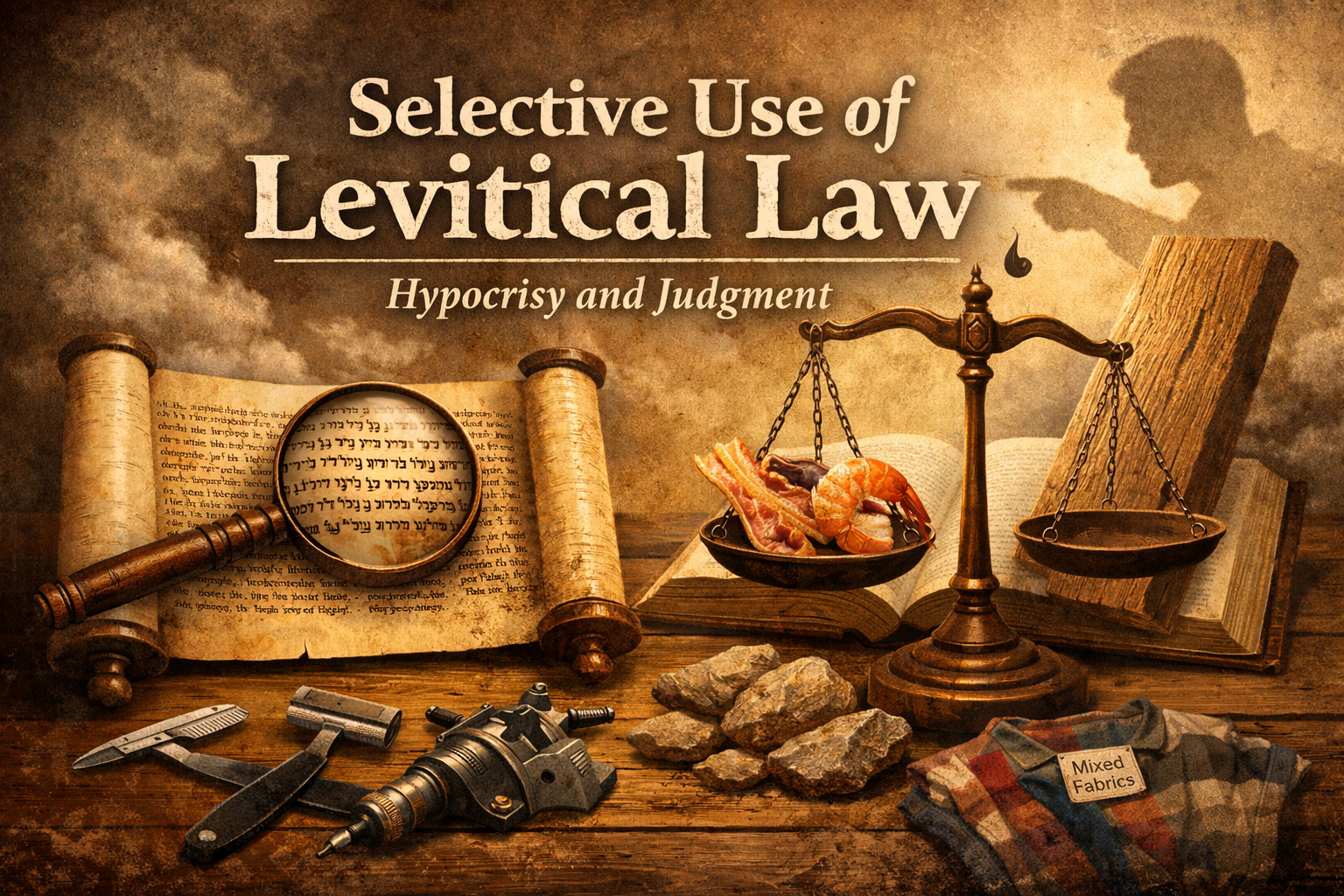
A recurring issue in religious discourse is the selective use of ancient laws to judge others while disregarding the same standards in one’s own life. This practice raises a serious theological and moral question: can a single command from an ancient legal code be isolated and enforced while the rest of that code is ignored?
The book of Leviticus contains an extensive collection of laws given to the people of ancient Israel. These laws governed diet, clothing, agriculture, worship practices, social conduct, labor, and moral behavior. They functioned as a comprehensive covenantal system, not a menu of optional rules to be applied selectively.
Yet, one of the most common patterns seen today is the citation of a single verse from Leviticus to condemn certain behaviors—particularly homosexuality—while ignoring the many other commands found in the same text .
The Context of Levitical Law
Levitical law was written within a specific historical and cultural context. It was given to a particular people group with the purpose of shaping their communal, spiritual, and ritual life. These laws addressed daily activities such as eating, farming, grooming, worship, family relationships, and financial dealings.
Treating Leviticus as a binding moral code in one area while dismissing its authority in others removes it from its original framework and turns it into a tool of convenience rather than a consistent standard .
Laws Commonly Ignored
Those who appeal to Leviticus for moral judgment often disregard numerous other commands found in the same book, including:
Dietary Laws
Prohibitions against eating pork and pork products.
Restrictions against consuming shellfish such as shrimp, lobster, and crab, which are explicitly labeled as abominations.
Bans on eating certain animal fats.
Appearance and Personal Practices
Instructions forbidding the trimming of beards and sideburns.
Prohibitions against tattoos.
Commands against wearing garments made of mixed fabrics.
Work, Finance, and Daily Life
Absolute rest on the Sabbath, including abstaining from all labor and household tasks.
Bans on charging interest on loans.
Agricultural rules against planting more than one type of seed in the same field.
Ritual and Social Conduct
Laws declaring individuals unclean due to contact related to menstruation.
Prohibitions against consulting mediums or psychics.
Severe penalties, including death, for cursing one’s parents.
Religious Observance
Mandatory celebration of specific annual feasts and festivals.
These laws are rarely enforced or even acknowledged in modern religious practice, despite being part of the same legal corpus that is often selectively cited .
Hypocrisy and Self-Examination
The selective enforcement of religious law raises a deeper ethical concern: hypocrisy. To ignore dozens of commandments while emphasizing one as a moral litmus test reveals bias rather than faithfulness. This approach transforms scripture into a weapon rather than a mirror.
This concern is addressed directly in Scripture itself:
“Why do you see the speck in your brother’s eye, but do not notice the plank in your own eye?”
(Matthew 7:3)
This teaching calls for humility and self-reflection rather than judgment. It challenges individuals to examine their own inconsistencies before condemning others.
A Call for Consistency and Integrity
If Levitical law is to be treated as binding authority, it must be applied in full. If it is not, then it should not be selectively wielded to condemn specific groups or behaviors. True integrity requires consistency, context, and compassion.
Rather than focusing on isolated verses, a more faithful approach is honest self-examination, recognition of one’s own shortcomings, and a commitment to fairness. Without these, selective obedience becomes hypocrisy, and judgment loses its moral credibility .