Rethinking “In the Beginning”: Creation as Order, Not Origin
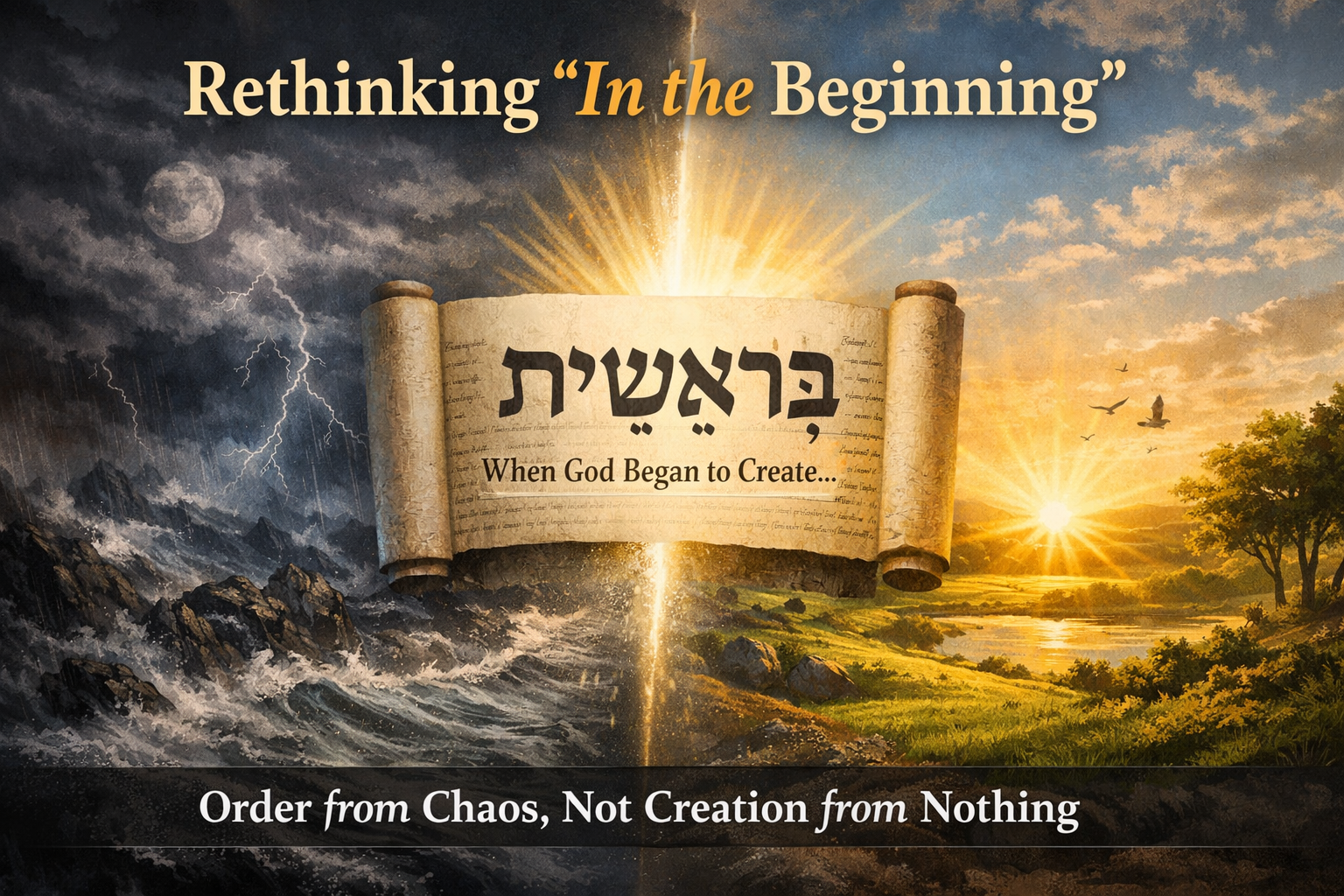
One of the most familiar opening lines in religious literature is commonly rendered as an absolute statement about the origin of everything: “In the beginning, God created the heavens and the earth.” Yet a closer examination of the original language reveals a far more nuanced and transformative understanding of creation—one that shifts the focus from absolute origins to purposeful ordering.
The Grammar That Changes Everything
At the heart of this reinterpretation is a linguistic feature of Biblical Hebrew known as the construct state. Unlike an absolute noun, which stands independently as a complete idea, a construct-state noun is inherently relational. It must be followed by another word to complete its meaning, forming an “X of Y” relationship.
The opening word traditionally translated as “in the beginning” is not in the absolute state. Instead, it appears in the construct state, which fundamentally alters how the phrase functions grammatically. Rather than declaring a complete and self-contained beginning, the phrase introduces a temporal clause—something more accurately conveyed as “when… began.” In this construction, the verse does not stand alone but sets the stage for what follows .
This grammatical distinction is not a minor technicality. Throughout the Hebrew scriptures, this word form consistently operates in relational expressions rather than absolute declarations. The language itself resists being read as a statement about creation emerging from nothing.
Creation as a Process, Not a Moment
When read as a temporal clause, the opening line becomes a framing device rather than a summary of cosmic origins. It signals that what follows describes events unfolding within an already existing reality. The next verse reinforces this by depicting a world that is present but unordered—characterized by darkness, depth, and undifferentiated matter.
Creation, in this portrayal, is not about bringing something into existence from nonexistence. Instead, it is about assigning form, function, and structure to what already exists. Light is separated from darkness. Spaces are organized. Boundaries are established. Meaning is imposed through order .
This model reframes creation as an act of organization rather than origination—a movement from chaos to cosmos.
Separating Text from Later Doctrine
The idea that creation must mean “from nothing” is often assumed to be intrinsic to the text itself. However, this assumption reflects later interpretive traditions rather than the linguistic and narrative logic of the original passage.
The construct-state reading reveals that the text does not argue for absolute beginnings at all. Instead, it describes divine activity operating upon an already-present, though unstructured, reality. The concept of creation ex nihilo—creation out of nothing—emerges much later as a philosophical and theological response to questions that are not addressed by the original language of the passage .
By disentangling the text from later doctrinal overlays, the narrative can be read on its own terms, guided by grammar, syntax, and internal coherence rather than inherited assumptions.
A Different Vision of Power and Purpose
This linguistic reframing does more than correct a translation—it reshapes the underlying vision of creative power. The emphasis is not on raw force conjuring reality out of nothing, but on wisdom, intention, and design bringing coherence to disorder.
Creation becomes an ongoing process of differentiation and meaning-making. The world is not summoned into being fully formed; it is shaped, structured, and given purpose through deliberate acts of separation and designation.
In this view, the opening of the creation narrative is less about answering where everything came from and more about explaining how order, meaning, and function emerge. It invites readers to see creation not as a single distant event, but as a pattern of transformation—chaos yielding to structure through purposeful action.
Conclusion
A single grammatical insight—the construct state of the opening word—opens the door to a radically different understanding of creation. What appears at first glance to be an absolute claim about origins is, in fact, an introduction to a story about ordering, structuring, and making sense of a world already present.
By reading the text according to its original linguistic framework, creation is revealed not as something-from-nothing, but as order-from-chaos—a narrative centered on meaning, purpose, and transformation rather than absolute beginnings.