Deconstructing Genesis 1:1 and the Myth of Creation Out of Nothing
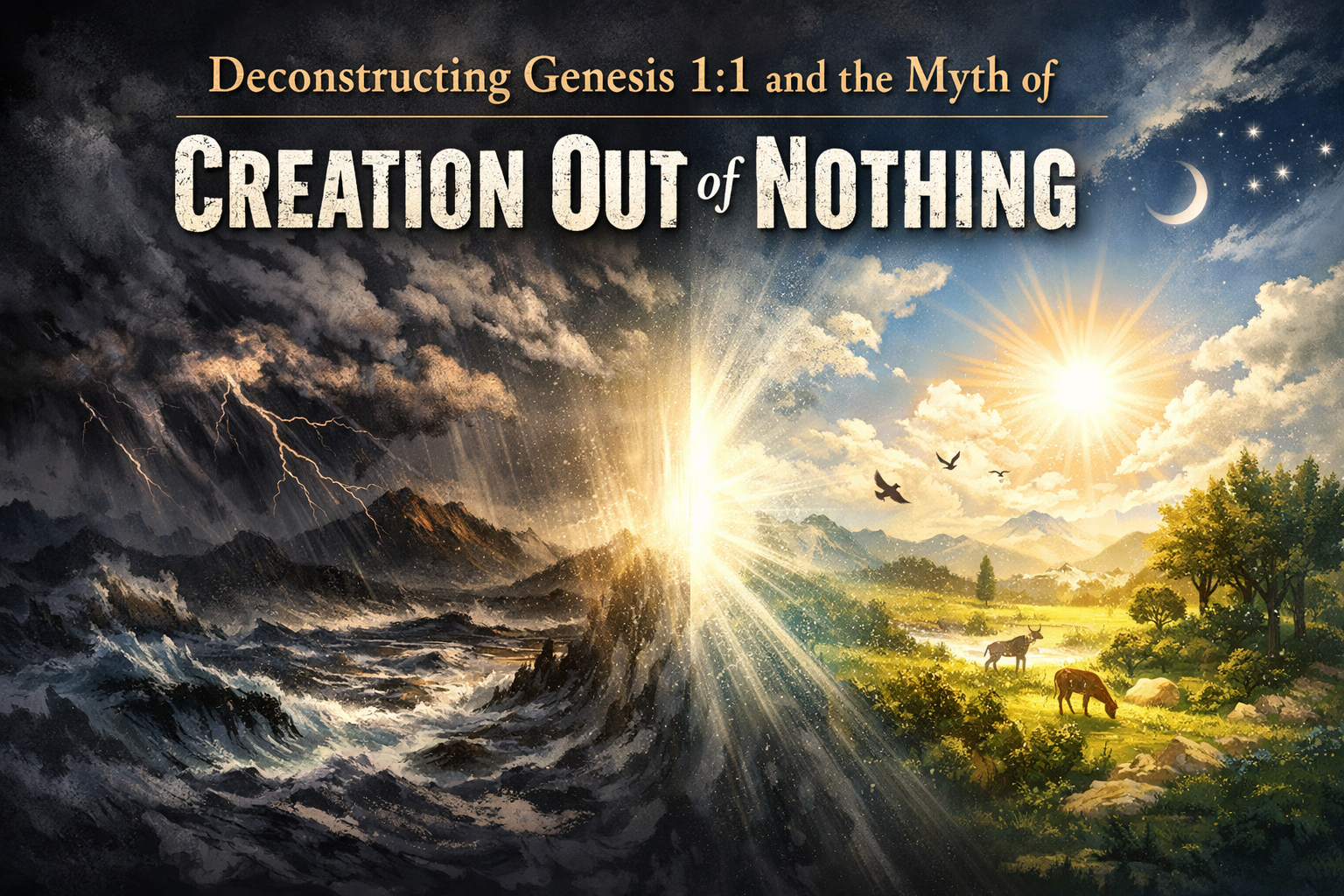
One of the most widely accepted ideas in modern theology is that the Bible teaches creation out of nothing, often referred to by the Latin phrase creation ex nihilo. This belief is commonly traced back to the opening line of Genesis: “In the beginning, God created the heavens and the earth.” Yet a closer examination of the original language, literary structure, and historical context reveals that this interpretation rests on later theological developments rather than the biblical text itself .
Rethinking “In the Beginning”
The foundation of the traditional interpretation lies in the translation of the Hebrew word Bereshit, the very first word of the Bible. While it is often rendered as “In the beginning,” this translation does not align with how the word functions in Hebrew grammar.
Bereshit appears in what is known as the construct state, a grammatical form that connects a noun to what follows it, indicating an incomplete phrase—similar to saying “the beginning of…” rather than a standalone “the beginning.” Notably, the Hebrew language already has a word that would clearly mean “in the beginning” in an absolute sense, and that word is not used here.
Because of this grammatical structure, Genesis 1:1 is better understood not as a complete sentence, but as a temporal clause. A more accurate rendering would be:
“When God began to create the heavens and the earth…”
This shift may seem subtle, but its implications are profound.
A World Already Present
When Genesis 1:1 is read as an introductory clause rather than a declaration of absolute beginnings, the following verse takes on new meaning. Genesis 1:2 describes the condition of the earth at the moment God began creating. The earth is already present, but it exists in a state of disorder—formless, empty, dark, and covered by deep waters.
Rather than depicting the creation of matter itself, the text describes God organizing, structuring, and giving function to an already-existing reality. The first creative act is not the formation of matter, but the introduction of light, which brings order and distinction to chaos.
In this reading, Genesis portrays creation as an act of ordering and differentiation, not as bringing something into existence from absolute nothingness.
The Absence of Creation Ex Nihilo in Scripture
When examined closely, the concept of creation out of nothing does not appear explicitly anywhere in the biblical texts. Instead, the imagery throughout Scripture consistently assumes the presence of chaotic matter that is shaped, divided, named, and given purpose.
This understanding aligns with ancient Near Eastern conceptions of creation, where gods were typically seen as imposing order on chaos rather than generating matter from nonexistence.
Where Did Creation Ex Nihilo Come From?
If the Bible itself does not clearly teach creation ex nihilo, where did the idea originate?
The doctrine emerged centuries after the biblical texts were written, during later theological debates. It was formulated in response to philosophical concerns about the nature of matter, divine sovereignty, and resurrection. These debates required new conceptual tools, and creation ex nihilo provided a way to assert total divine control over existence itself.
Importantly, this doctrine reflects later theological reasoning, not the worldview of the biblical authors.
Addressing Philosophical Counterarguments
Some later texts use language suggesting things were made “from what is not.” However, this phrasing reflects a philosophical framework in which “non-being” refers not to literal nothingness, but to matter lacking form, purpose, or function.
Within this framework, something could exist materially yet still be described as “not being” because it had not yet been shaped into something meaningful. This idea is fundamentally different from the claim that nothing at all existed prior to creation.
Reframing the Creation Story
When Genesis 1 is read through the lens of its original language and cultural context, it presents a creation story focused on order, purpose, and structure, not metaphysical origins. God’s creative work is shown as transforming chaos into a functional cosmos, assigning roles to light, land, seas, celestial bodies, and living creatures.
This perspective does not diminish the power or significance of the creation narrative. Instead, it grounds it more firmly in its ancient context and invites readers to reconsider long-held assumptions shaped by later theological traditions.
Conclusion
The idea that Genesis teaches creation out of nothing is not rooted in the text itself, but in interpretations that arose long after it was written. A careful reading reveals a different, and arguably richer, vision of creation—one centered on bringing order, meaning, and purpose to a world already present.
By returning to the language and structure of the text, Genesis 1 can be understood not as a statement about absolute beginnings, but as a powerful story of transformation, order, and intentional design .