Deconstructing Biblical Authority: A Call for Personal Discernment
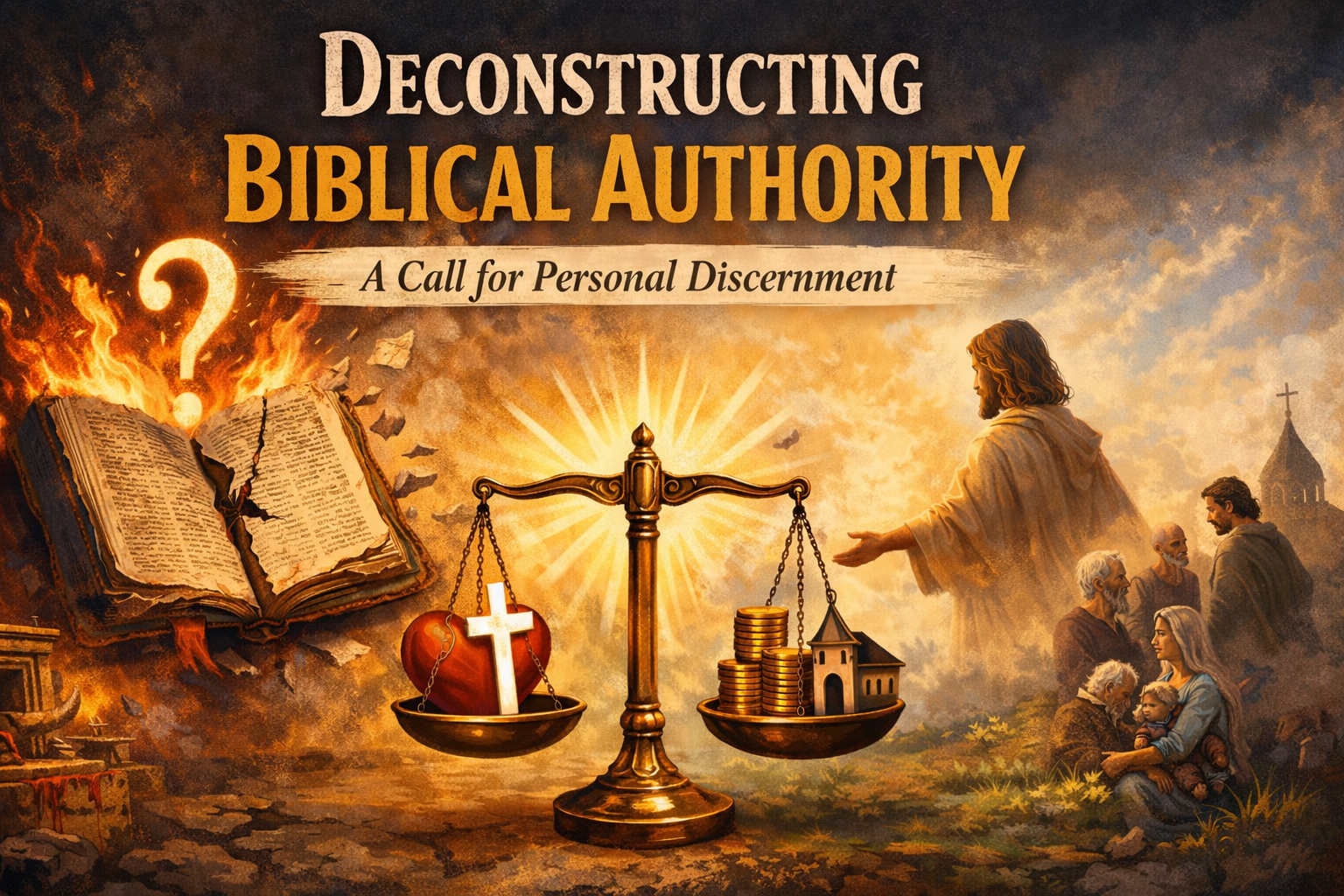
For centuries, the Bible has been treated by many as a flawless, divinely protected text—an unquestionable authority governing belief, morality, and spiritual identity. Yet a growing body of critical reflection challenges this assumption, arguing that unquestioning acceptance of scripture overlooks deep historical, ethical, and theological problems. This perspective calls for a reexamination of biblical authority and a return to personal discernment grounded in love, conscience, and responsibility.
The Problem of Absolute Trust in Scripture
At the heart of this critique is the assertion that no part of the Bible can be trusted one hundred percent. The reasoning is simple: contradictions, internal inconsistencies, and historical discontinuities indicate human influence and editorial intervention. If a text claims divine perfection yet contains conflicting portrayals of God, morality, and justice, it invites honest scrutiny rather than blind allegiance.
Relying entirely on a multi-volume collection of writings—compiled, edited, and selected by human institutions—raises an important question: why would an all-loving, all-knowing God require such a complex and disputed system to communicate a message that is, at its core, simple? The ethical heart of faith is repeatedly summarized as loving God and loving one’s neighbor. If this principle fulfills all moral law, then unquestioned loyalty to every passage of scripture may represent not devotion, but spiritual complacency .
Historical Shaping of the Old Testament
One major concern centers on the formation of the Old Testament. The argument presented is that large portions of these texts were heavily edited during periods of political and religious consolidation, particularly to support temple-centered religious systems. These systems tied forgiveness and divine favor to ritual sacrifice, effectively placing spiritual access under institutional control.
According to this view, such structures benefited religious authorities materially and socially, transforming faith into an economy built on obligation and fear. When forgiveness is commodified—whether through offerings, rituals, or compliance—the spiritual message becomes entangled with power and profit. This raises serious doubts about whether such systems accurately reflect a God defined by compassion and justice, or whether they instead reveal the priorities of human institutions .
Tension Between Jesus’s Teachings and Later Theology
The critique continues into the New Testament, drawing a sharp distinction between the teachings attributed to Jesus and later theological frameworks that developed after his death. Jesus is portrayed as challenging religious systems that burdened the poor, excluded the marginalized, and prioritized ritual over mercy. His message emphasized care for others, humility, and direct relationship with God.
Later interpretations, however, shifted focus toward doctrines centered on sacrifice, sin payment, and institutional authority. These developments are framed as a rebranding of earlier sacrificial systems rather than their abolition. In this telling, theology evolved in ways that mirrored the structures Jesus opposed—only with different mechanisms for control and compliance. Additionally, questions are raised about the reliability of gospel accounts, noting their distance in time from the events they describe and their reliance on evolving oral traditions rather than firsthand testimony .
Moving Beyond “Worshiping a Book”
A central theme of this perspective is the danger of elevating scripture itself to an object of devotion. When faith becomes about defending a text at all costs, ethical reasoning and compassion can be sidelined. Harmful teachings may be justified simply because they appear in scripture, even when they contradict love, empathy, and justice.
This approach challenges the idea that faithfulness means suspending moral judgment. Instead, it argues that moral awareness and conscience are not threats to spirituality but essential components of it. Discernment, curiosity, and questioning are framed not as rebellion, but as responsibility.
A Litmus Test Rooted in Love
Rather than rejecting scripture entirely, this framework proposes a practical method for engagement: a personal litmus test. Any teaching, passage, or doctrine should be evaluated by a simple question—does it help cultivate love for God and love for others?
If a passage encourages compassion, humility, forgiveness, and care for one’s neighbor, it may be worth embracing. If it promotes fear, exclusion, violence, or dehumanization, it should be questioned, regardless of its place in a sacred text. This process relies on conscience, discernment, and spiritual awareness rather than institutional enforcement or inherited dogma .
Reclaiming Personal Responsibility in Faith
Ultimately, this call for personal discernment is not an attack on faith, but an invitation to mature within it. It challenges spiritual passivity and urges individuals to take ownership of their beliefs, ethics, and relationship with the divine. Rather than outsourcing moral judgment to ancient texts or religious authorities, faith becomes a lived practice rooted in love, integrity, and accountability.
In this view, the most authentic spirituality is not found in defending the perfection of a book, but in embodying the principles of compassion and justice that transcend any single text.