The Historical Invention of Modern Hell
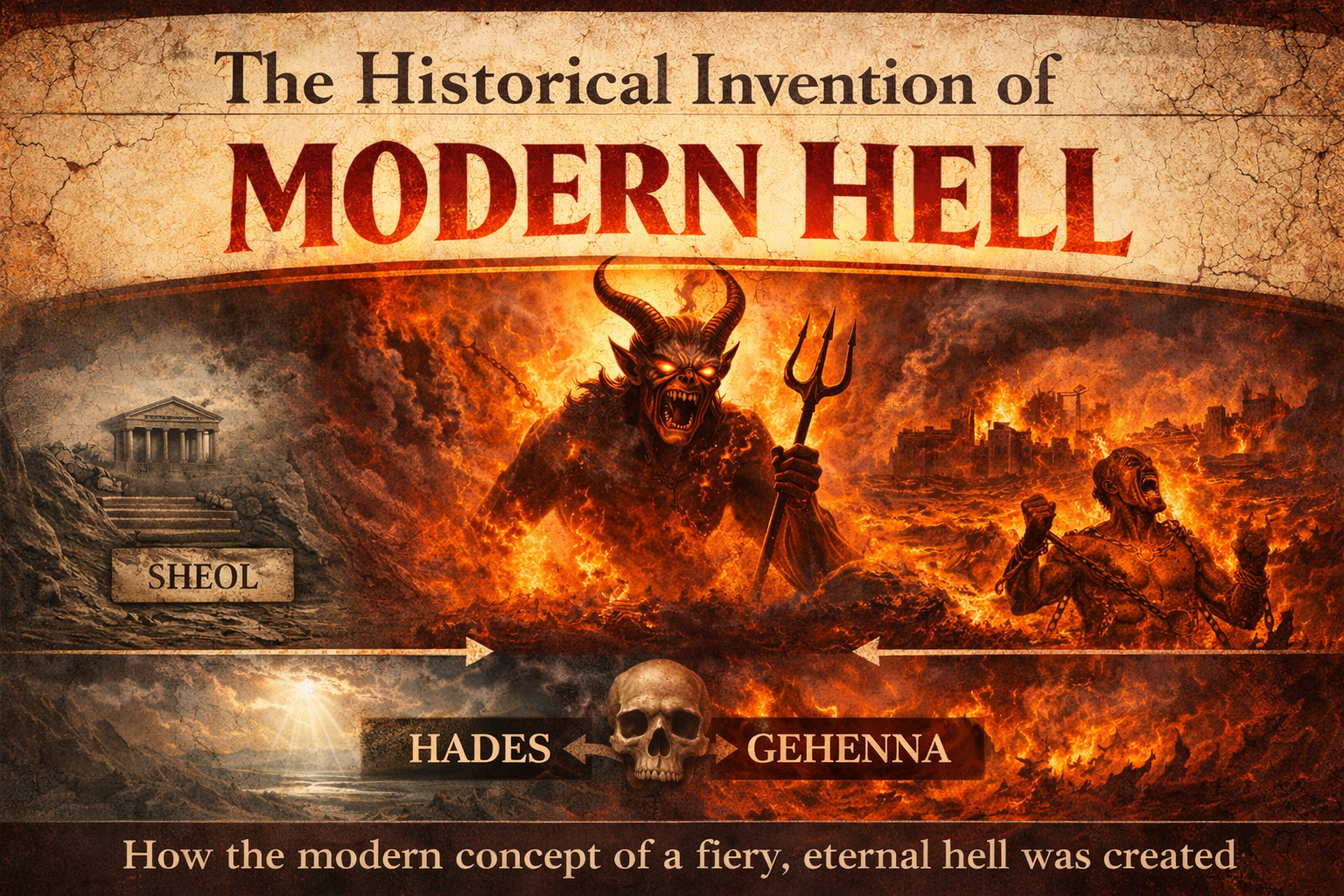
The modern image of hell as a fiery realm of eternal torment is deeply embedded in contemporary religious culture. Flames, demons, endless suffering, and punishment beyond death are often assumed to be foundational beliefs. However, a closer historical and textual examination reveals that this concept is not an original part of early biblical theology. Instead, it emerged gradually through translation shifts, cultural influences, and post-biblical interpretation.
This article explores how the idea of modern hell developed over time—and why it does not appear in the earliest scriptural traditions.
No Hell in the Old Testament
For roughly the first thousand years of biblical history, the concept of an eternal place of punishment simply does not exist in the Hebrew scriptures. Instead, all people—righteous and wicked alike—were believed to go to Sheol after death.
Sheol was not portrayed as a place of torture, fire, or judgment. It functioned as a neutral destination for the dead, often described as a shadowy or inactive state of existence. There were no demons, no flames, and no eternal suffering. It was not a reward or a punishment, but rather a universal outcome of mortality.
This absence is significant: if eternal torment were a central divine doctrine, it would be expected to appear clearly in these foundational texts. It does not.
Language Shifts and the New Testament
The arrival of the New Testament does not introduce the modern idea of hell either. The language often translated as “hell” originates from terms with very different meanings.
One such term is Gehenna, which referred to a real, physical location outside Jerusalem—a refuse valley associated with waste, decay, and destruction. It was a symbol of judgment and ruin, not a supernatural realm of eternal punishment.
A major shift occurred when Hebrew texts were translated into Greek. The neutral term Sheol was replaced with Hades, a concept borrowed directly from Greek mythology. Unlike Sheol, Hades carried mythological connotations of an underworld with moral consequences. This substitution marked a turning point where external cultural imagery began to influence religious interpretation.
The Post-Biblical Construction of Hell
The fully developed idea of hell as a place of everlasting torment did not solidify until after the biblical period. Over time, religious leaders combined elements from multiple sources:
The neutral afterlife of Sheol
The symbolic destruction associated with Gehenna
Mythological underworld imagery from surrounding cultures
These elements were fused into a single, fear-driven narrative. Eternal punishment became a powerful tool for enforcing moral behavior and maintaining institutional authority. The emphasis shifted from spiritual transformation to fear of consequences after death.
As these ideas spread, the imagined details of hell became increasingly vivid and dramatic, embedding themselves deeply in cultural consciousness—even though they were not grounded in early scripture.
What the Earliest Christians Believed
Early Christian communities did not universally accept the concept of endless torment. Many held that the ultimate consequence of judgment was annihilation—the complete cessation of existence—rather than perpetual suffering.
This view saw death as final, not punitive. There was no eternal fire, no ongoing torment, and no cosmic torture. Judgment meant loss of life, not eternal pain.
This understanding aligns more closely with earlier biblical traditions and contrasts sharply with later depictions that dominate modern imagination.
Rethinking a Familiar Doctrine
The idea of hell as an eternal torture chamber is not found in the earliest biblical texts. It is the product of centuries of reinterpretation, translation choices, cultural influence, and institutional development.
Recognizing this history invites a reconsideration of deeply held assumptions. When confronted with the threat of eternal torment, one might reasonably ask whether that version of hell was ever part of the original message—or whether it was added long after the foundations were laid.
According to the historical record, the modern concept of hell was not present at the beginning. It was written in later.