Biblical Contradictions in the Narrative of Cain
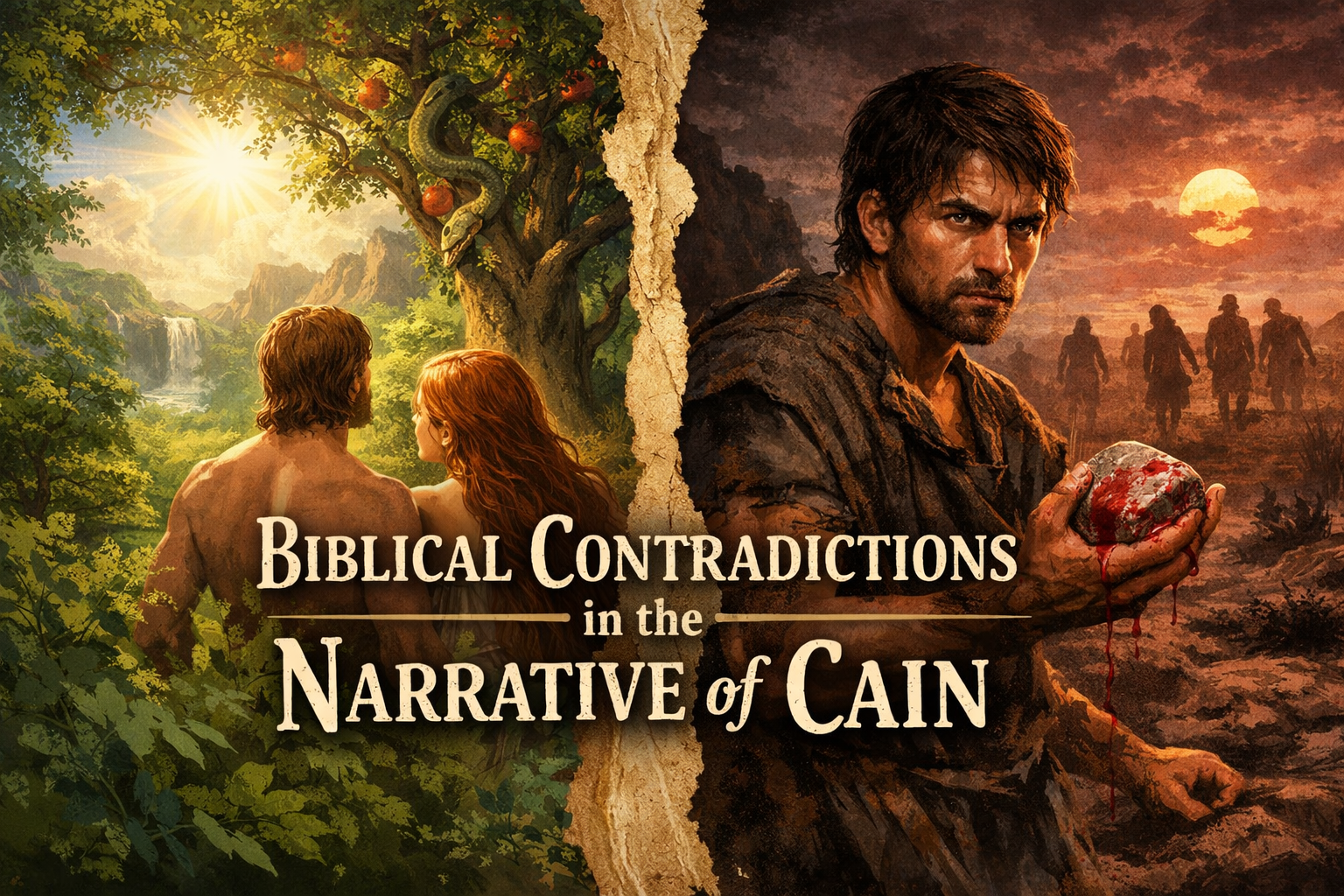
The story of Cain in Genesis chapter 4 is often read as a continuation of the creation narrative found in the preceding chapters. However, a closer reading reveals internal tensions that challenge the idea of a single, unified account of humanity’s beginnings. These inconsistencies suggest that the narrative of Cain assumes a world already populated with people, a premise that does not align with the earlier portrayal of Adam and Eve as the first and only humans.
An Assumed Populated World
Genesis chapters 2 and 3 describe a world occupied solely by Adam, Eve, and their immediate offspring. By contrast, Genesis chapter 4 introduces details that appear to contradict this limited population.
After killing his brother, Cain expresses fear that others who encounter him might recognize his crime and kill him in retaliation. This concern implies the existence of people beyond his immediate family—individuals who are numerous enough to pose a real threat. If only Adam and Eve remained, such fear would seem unnecessary and illogical.
The narrative also introduces Cain’s wife without explanation. Genesis 4:17 states that Cain “knew his wife,” yet provides no information regarding her origin. The text does not describe her as a sister, nor does it explain where she came from. This omission creates a significant narrative gap if the story is meant to be understood as occurring in a world with only one human family.
The Problem of Narrative Coherence
These elements indicate that Genesis 4 operates under assumptions different from those presented earlier in the text. The chapter appears to presuppose a broader human population, suggesting that the Cain narrative may stem from a tradition that did not originally share the same origin story found in Genesis 2–3.
Over time, interpreters have attempted to harmonize these passages by proposing that Adam and Eve had many unmentioned children, and that Cain’s wife came from among them. According to this explanation, early humanity engaged in incestuous relationships that were later prohibited. While this approach seeks to preserve narrative unity, it requires substantial assumptions that are not supported by the text itself.
A Composite Text with Multiple Traditions
The tension within the Cain story highlights a broader pattern found throughout the Hebrew Scriptures: the presence of multiple traditions woven together into a single text. Rather than presenting a seamless historical account, Genesis reflects layers of storytelling that were preserved and transmitted over time, even when their details did not fully align.
Understanding the Cain narrative in this way does not diminish its theological or literary value. Instead, it invites readers to engage the text more honestly, recognizing its complexity and the ways in which ancient communities grappled with questions of violence, exile, and human identity.
Conclusion
The narrative of Cain challenges simplistic readings of Genesis by revealing internal contradictions about the origins and population of humanity. Cain’s fear of others and the unexplained appearance of his wife suggest that Genesis chapter 4 assumes a world already inhabited, standing in tension with earlier creation accounts. Rather than forcing these passages into artificial harmony, acknowledging their differences allows for a deeper and more nuanced understanding of the biblical text as a collection of ancient traditions preserved side by side.