I grew up memorizing Bible verses, attending Sunday school, and never questioning where this book actually came from. The Bible was simply there—complete, authoritative, unquestionable. Years passed before I asked the most basic question: who decided what went in it?
The answer changed everything I thought I knew about Christianity.
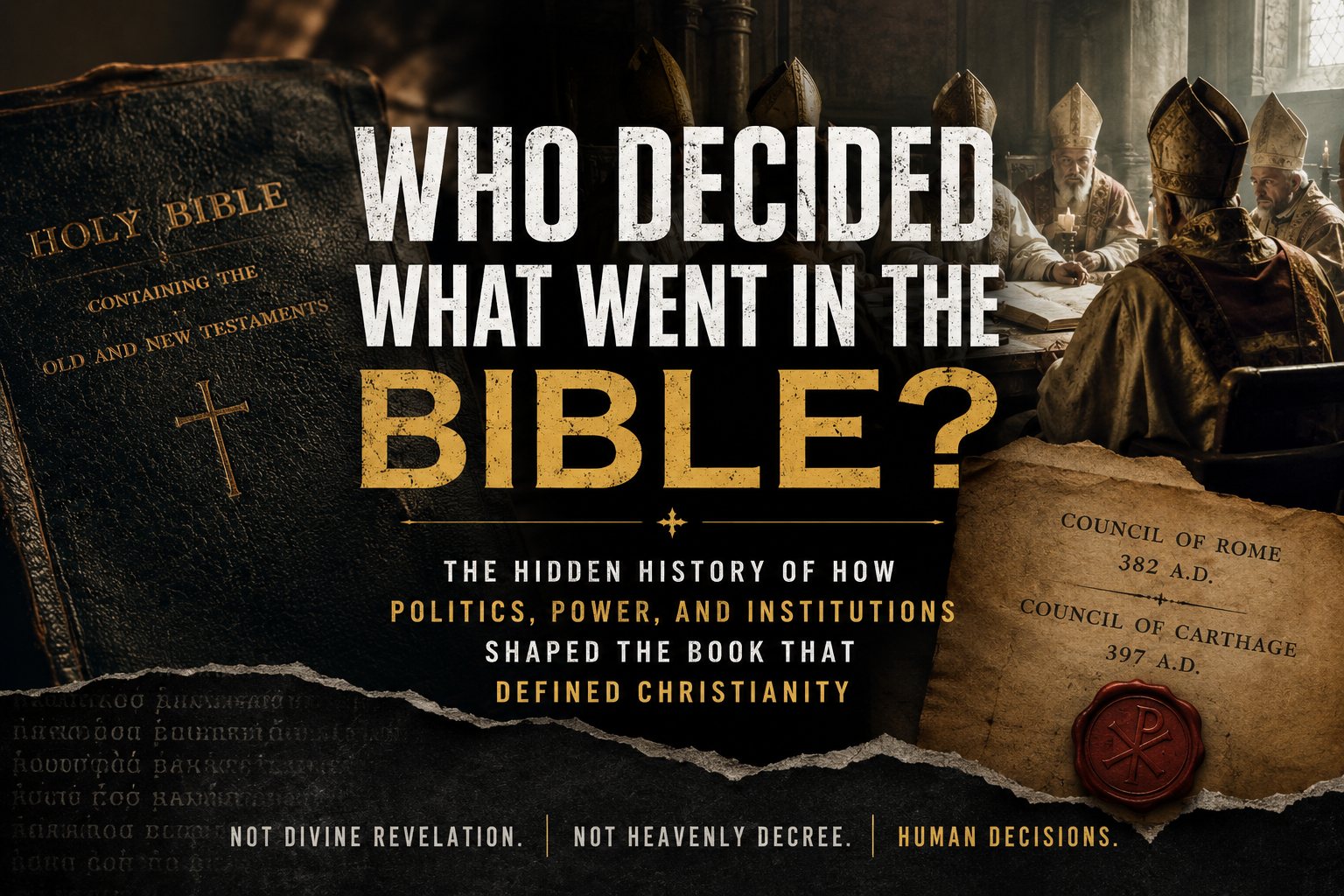
The Bible didn’t arrive as a complete package. No divine table of contents appeared in the sky. Instead, Catholic bishops gathered in rooms and voted. The Council of Rome in 382 A.D. The Council of Carthage in 397 A.D. These were political meetings where men with institutional power decided what texts would define Christianity for the next two millennia.
Let that sink in. The very foundation of Christian faith—that the Bible represents God’s word—stems from decisions made by Catholic church officials. Not from divine revelation. Not from heavenly decree. From human beings who held political power and had institutions to protect.
When I share this historical fact with other Christians, I get predictable pushback: “God wouldn’t allow His book to be corrupted.” But this response assumes what we’re questioning—that the Bible is God’s book to begin with. You can’t prove something by assuming it’s already true. That’s circular reasoning at its most basic level.
The problems compound when you examine specific verses. Take 2 Timothy’s famous declaration that “all scripture is God-breathed.” Most biblical scholars now consider this letter a forgery—someone in the second century wrote it while pretending to be Paul, specifically to bolster the Roman church’s growing authority. The very verse used to establish the Bible’s divine nature comes from a text that lies about its own authorship.
Then there’s the numbers problem. Catholics recognize 73 books as scripture. Protestants accept only 66. The Ethiopian Orthodox Church includes 88. If the Bible truly represents God’s perfect word, which version got it right? How can there be three different answers to what God supposedly said? These aren’t minor editorial differences. They’re fundamental contradictions that point directly to human construction rather than divine authorship.
Consider the political context. When the Roman Empire adopted Christianity as its state religion, they weren’t looking for a faith that would empower individuals. Governments don’t want citizens believing they possess divine authority within themselves. That threatens institutional control. They needed something manageable, something that would maintain order and hierarchy.
This explains why certain texts made the cut while others disappeared. The message Jesus actually taught—that each person carries divine authority within themselves—was revolutionary. Both Jewish temple leadership and Roman government recognized him as a threat because he challenged their entire power structure, not just their theology.
The established church conditions believers from childhood to accept without investigation. We memorize verses, recite creeds, and never examine how these texts were selected, compiled, and edited. But when you study the actual historical process, the institutional narrative falls apart. You see how a message of personal divine empowerment got buried under layers of institutional control.
I’ve watched people become visibly uncomfortable when presented with these historical facts. The discomfort doesn’t come from the facts being wrong—it comes from those facts threatening everything they’ve built their faith on. Many prefer ignorance to confronting the possibility that their beliefs serve institutional interests more than spiritual truth.
For nearly two thousand years, this system has functioned brilliantly. People accept a version of Christianity filtered through Roman political interests. The same empire that executed Jesus for his teachings later determined which teachings would survive and how they’d be interpreted. The irony is staggering.
The men who compiled the Bible weren’t neutral observers recording divine truth. They were political actors with specific agendas, operating within an imperial system that required religious unity for social stability. Every decision they made—which books to include, which to exclude, how to translate certain passages—served institutional purposes.
This doesn’t strip all value from biblical texts. Many contain genuine wisdom and spiritual insight. But treating them as God’s infallible word, when human beings with political motivations clearly selected and edited them, prevents honest engagement with their actual content.
The real question isn’t whether God exists or whether Jesus taught something important. The question is whether we’re willing to look past institutional packaging to find the actual message. Can we admit that the Bible’s authority comes from men who had every reason to shape that message for their own purposes?
Strip away the institutional framing. Stop accepting circular arguments about divine authorship. You might discover something more profound than what organized religion has been selling. You might find that the original message centered on recognizing your own divine nature, your own direct connection to the source, without institutional mediation.
That message got Jesus killed. And that message has been systematically buried under claims of exclusive divine authority by successive religious institutions. The Bible, as compiled and presented to us, serves that burial more than liberation.
We’ve been operating under a religious framework designed by an empire for imperial purposes. The texts were selected to serve power, not truth. The translations were shaped to support authority, not understanding. The interpretations were crafted to maintain control, not inspire freedom.
Once you see this, you can’t unsee it. The comfortable certainty of accepting inherited beliefs gives way to uncomfortable questions. Why do we trust the word of fourth-century politicians about what constitutes God’s word? Why do we accept their compilation as divinely inspired when the historical record shows it was entirely human-driven?
The cognitive dissonance hits hard. Everything you’ve been taught, every assumption you’ve carried, every belief you’ve defended—all of it rests on the decisions of men who had clear political and institutional motivations. Men who weren’t there when Jesus taught. Men who never met the apostles. Men who lived centuries after the events they were canonizing.
I’m not saying throw everything out. I’m saying examine it honestly. Look at the historical record. Study how the canon formed. Learn who made these decisions and what motivated them. Stop accepting institutional claims at face value and start investigating for yourself.
What you’ll find is a human document created for human purposes. A collection of texts selected to serve an empire’s needs for social cohesion and control. A carefully curated anthology designed to channel spiritual impulse through institutional structures rather than personal revelation.
The tragedy isn’t that people find meaning in these texts—many do, and that’s valuable. The tragedy is that by accepting them as divinely ordained rather than humanly constructed, we miss their actual message. We mistake the packaging for the product. We confuse institutional interpretation with spiritual truth.
Jesus challenged institutional religious authority. He told people they didn’t need temple mediation to connect with the divine. He proclaimed that the kingdom of God was within. These teachings threatened every power structure of his time. So those power structures killed him, then spent centuries reshaping his message to support the very systems he opposed.
The Bible we have today is the result of that reshaping. It’s a document that tells us to submit to authority, to wait for salvation from outside ourselves, to trust institutional interpretation over personal revelation. It’s everything Jesus stood against, wrapped in his name and sold as his message.
When you understand this history, when you see how the sausage was made, you face a choice. Continue accepting institutional claims about divine authorship, or acknowledge the human fingerprints all over this text. Keep believing that fourth-century politicians had unique access to God’s will, or recognize that they were simply men protecting their power.
I chose to recognize the human construction. That choice freed me to engage with these texts differently—not as infallible divine commands, but as human attempts to understand and explain spiritual experience. Some succeed brilliantly. Others serve mainly to reinforce institutional authority. But none of them fell from heaven fully formed.
The real spiritual journey begins when you stop accepting pre-packaged answers and start asking your own questions. When you stop trusting institutional authority and start trusting your own connection to whatever you understand as divine. When you stop believing that God speaks only through approved channels and start listening for yourself.
That’s the message I think Jesus actually taught. That’s the message that got him killed. And that’s the message that two thousand years of institutional Christianity has worked to suppress, using the very book that supposedly preserves his teachings.
The truth is uncomfortable but necessary: we’ve inherited a religious framework designed by an empire for imperial purposes. Recognizing this doesn’t destroy faith—it clarifies it. It separates genuine spiritual insight from institutional control. It distinguishes between wisdom worth preserving and propaganda worth discarding.
Once you see it, everything changes. The Bible becomes a human document with human purposes. The church becomes an institution with institutional interests. And your spiritual journey becomes yours to define, not theirs to control.